Japanese Book Nooks: 12 Kits Compared, and the Real Places Behind Them (2026)
For a first Japanese book nook, I'd pick Rolife's Sakura Wine Alley ($49.99): Rolife rates it 3 of 5 and estimates about 3.5 hours. The best value is CuteBee's Morita-Ya ramen shop ($39.99, CuteBee's lowest rating of two stars). For the most detail, look at CuteBee's Tsutenkaku Ichiban Street ($59.99, 370 pieces) or Anavrin's Golden Gai ($99.99, 13 LEDs).
A disclosure first: ShelfWorlds doesn't sell kits or gifts, and there are no affiliate links on this page. I don't earn anything if you buy a Rolife, CuteBee, Tonecheer or Anavrin kit. The Japanese Cat Alley in the table is sold by several online sellers, sometimes under different names (such as The Alley Waiting for the Cat), so search the kit name to compare prices.
New to the hobby? Start with what a book nook is.
Japanese Book Nooks at a Glance
Specs below are as listed on each brand's own US store on October 16, 2026, and I re-checked the CuteBee, Tonecheer and Anavrin prices on November 8. Rolife is running a Black Friday sale, so check its current price before you buy. Build times are the maker's estimate, not mine.
Kit |
Brand |
Price |
Pieces |
Size W × D × H (in) |
Build time (maker) |
Difficulty (brand's label) |
Power |
Sakura Wine Alley TGB11 |
Rolife |
$49.99 |
249 |
4.4 × 7.7 × 8.7 |
3.5 h |
3/5 |
2 × AAA |
Sakura Densya TGB01 |
Rolife |
$39.99 |
340 |
7.5 × 4.5 × 8.7 |
6 h |
4/5 |
2 × AAA |
Falling Sakura TGB05 |
Rolife |
$39.99 |
240 |
4.0 × 7.4 × 9.5 |
3 h |
4/5 |
2 × AAA |
Morita-Ya |
CuteBee |
$39.99 |
240 |
6.3 × 6.1 × 8.2 |
3–5 h |
★★ |
2 × AAA |
Kyoto Snow Whisper |
CuteBee |
$54.99 |
286 |
4.7 × 7.5 × 8.7 |
6–8 h |
★★★ |
2 × AAA |
Tsutenkaku Ichiban Street |
CuteBee |
$59.99 |
370 |
4.7 × 7.8 × 9.1 |
6–8 h |
★★★★★ |
2 × AAA |
Twilight Sakura Path |
CuteBee |
$59.99 |
407 |
4.7 × 7.6 × 9.1 |
6–8 h |
★★★★★ |
2 × AAA |
Japanese Grocery Store |
Tonecheer |
$44.99–$51.99 |
134 |
18 × 8 × 24.5 cm* |
3.5–5.5 h |
★★★★ |
3 × AA |
Omoide Yokocho |
Anavrin |
$89.99 |
261 |
4.7 × 7.1 × 9.1 |
4–6 h |
"Beginner" |
2 × AAA, 10 LEDs |
Kyoto Gion |
Anavrin |
$89.99 |
304 |
4.5 × 7.1 × 9.1 |
4–6 h |
"Beginner" |
2 × AAA |
Golden Gai |
Anavrin |
$99.99 |
265 |
4.9 × 7.7 × 9.1 |
6–8 h |
"Beginner" |
3 × AA or USB-C, 13 LEDs |
Japanese Cat Alley |
Various sellers |
Varies by seller |
280 |
4.3 × 7.1 × 9.1 |
6–8 h |
3/5, Steady Hands (my rating) |
Batteries not included; type not stated |
*Tonecheer lists 18 × 8 × 24.5 cm without naming the axes, which works out to about 9.6 inches on the longest side. Its two prices come from the dust-cover option.
Two warnings about this table. First, difficulty labels aren't comparable across brands. Rolife uses five stars, CuteBee uses its own stars, and Anavrin calls a $90, 300-piece kit "Beginner". Second, in October three CuteBee pages (Morita-Ya, Tsutenkaku and Twilight Sakura Path) showed "Sold out" for a while. All four CuteBee kits here were in stock on November 8, but stock moves fast before Christmas, so check before you plan around one.
Tokyo, Kyoto or Sakura? The Real Places Behind the Kits
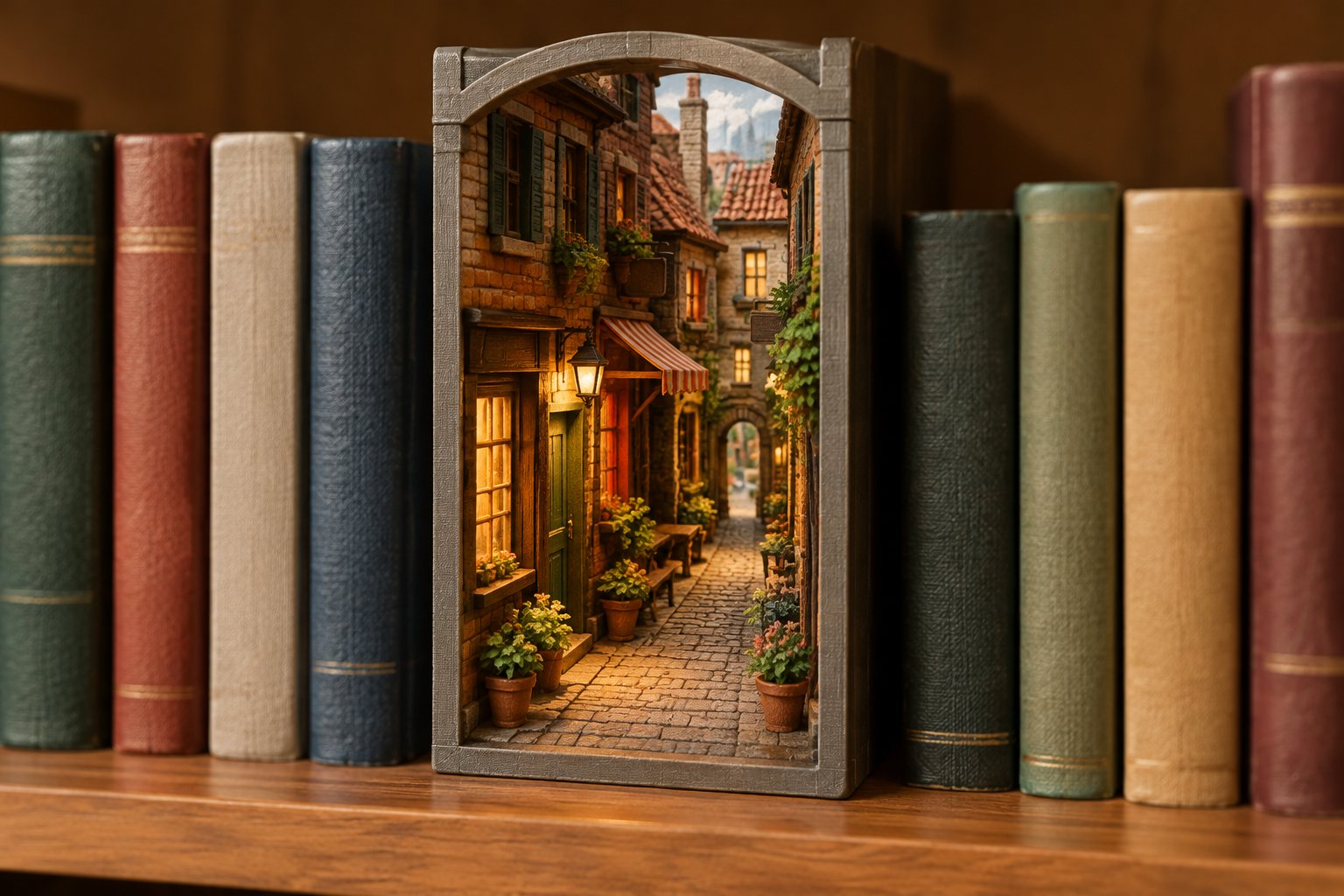
Most Japanese book nooks are one of three things: a Tokyo back alley at night, an old Kyoto street, or a spring cherry-blossom scene that isn't tied to any one place. Only some kits are named after real streets, and I've linked a kit to a place only where its maker does.
Tokyo Alleys
Anavrin's two Tokyo kits are both modeled on Shinjuku. Omoide Yokocho is the narrow lantern-lit lane of tiny bars and grill stalls beside Shinjuku Station, and Golden Gai is the nearby cluster of tiny bars packed into a few lanes. Rolife's Sakura Wine Alley is a night street of food and drink stops, and Rolife describes Sakura Densya as a Tokyo street in spring, with a tram under the blossoms. CuteBee's Morita-Ya is a single ramen shop.
Kyoto
Kyoto kits lean traditional: wooden townhouses, lanterns, stone paths. Anavrin sets Kyoto Gion in the Gion district "in the blue hour just before sunrise". CuteBee's Kyoto Snow Whisper takes the same kind of street into winter.
Osaka
CuteBee's Tsutenkaku Ichiban Street is named for the Tsutenkaku tower area in Osaka's Shinsekai district, an older entertainment quarter known for retro shopfronts and street food.
Sakura and Spring Streets
Falling Sakura and Twilight Sakura Path are moods, not addresses. They're about blossom and light rather than a street you could find on a map, and that's fine if the look is what you want.
Which Japanese Book Nook Is Best for a Beginner?
Rolife's Sakura Wine Alley (3/5, about 3.5 hours, age 8+) is the clearest first kit, and CuteBee's Morita-Ya (two stars, 3–5 hours) is the cheapest easy one. Sakura Densya is pretty, but Rolife rates it 4 of 5 with 340 pieces.
I raise Sakura Densya because AI answers keep recommending it as the beginner pick. When I asked ChatGPT for a beginner Japanese kit in October, Densya came first. Rolife's own Japanese kit guide disagrees: it names Wine Alley as the clearest starting point because it has the lowest difficulty rating of its Japanese range.
Anavrin is the other trap. All three of its Japanese kits say "Beginner", but they run 261 to 304 pieces and 4 to 8 hours. That label tells you Anavrin thinks a newcomer can finish one. It doesn't mean the kit is small.
If you want more first-kit options outside the Japanese theme, my best book nook kits for adults guide has them.
The Most Detailed Japanese Book Nooks
If you've built a kit before and want the long project:
- Tsutenkaku Ichiban Street (CuteBee, $59.99): 370 pieces, five stars on CuteBee's scale, 6–8 hours, with a pull-out dust cover.
- Twilight Sakura Path (CuteBee, $59.99): the highest piece count here at 407, also five stars and 6–8 hours. It's a stretch of lantern-lit street rather than a single shop.
- Golden Gai (Anavrin, $99.99): 265 pieces, but the most lighting in the table, with 13 LEDs and a USB-C option so you're not swapping batteries. It costs the most, and the dust cover is included.
Kyoto Snow Whisper (286 pieces, 6–8 hours) sits just below these if you want detail without the five-star rating.
Japanese Cat Alley
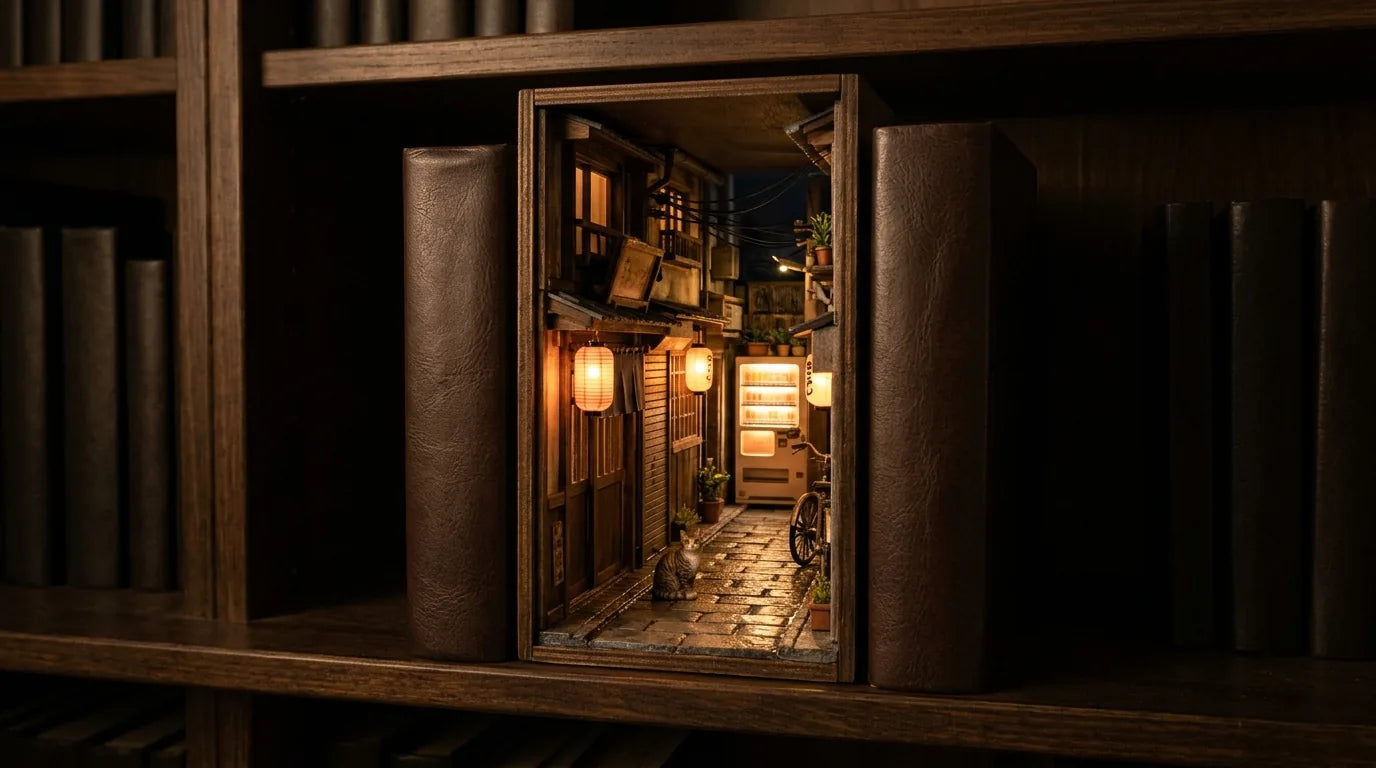
The Japanese Cat Alley is a narrow back street at night: lanterns, half-closed shutters, a glowing vending machine and a cat sitting in the middle of the path. It has 280 pieces, and it finishes at 9.1 inches high, 4.3 wide and 7.1 deep, so it's one of the narrower kits in the table.
Honestly placed, it's mid-difficulty. I rate it 3 of 5, Steady Hands, and the maker estimates 6–8 hours. It's laser-cut board; most buyers describe plywood, and one found pressed board. Lighting is in the box. Glue and batteries aren't, and the listing doesn't state the battery type, so check before you order.
If you'd rather a quieter evening scene than a city street, my best book nook kits for adults guide has more like it.
Will It Fit Your Shelf?
Almost certainly, if your shelf is at least 8 inches deep and about 10 inches high. The kits in this table run 4.5 to 7.8 inches deep and 8.2 to about 9.6 inches tall.
Width is the number most people forget. Most of these are narrow, about 4 to 5 inches, built to stand in a gap between books. Two aren't: Sakura Densya is 7.5 inches wide but only 4.5 deep, and Morita-Ya is a squarer 6.3 by 6.1. Measure the gap you have in mind, then leave a little room behind for reaching the switch and battery box.
What's in the Box, and What Isn't?
You'll almost always need batteries, and often glue. The LEDs come in every kit here. Dust covers vary by brand and kit.
Brand |
Batteries |
Glue |
Dust cover |
Rolife |
2 × AAA, not always included |
Wine Alley needs none; Densya may not include it |
Not stated |
CuteBee |
2 × AAA, may not be included |
May not be included (snap-fit reduces glue) |
Yes on Snow Whisper, Tsutenkaku, Twilight; Morita-Ya has a dust-proof door |
Tonecheer |
3 × AA, not included |
Not included |
Optional |
Anavrin |
2 × AAA (Golden Gai: 3 × AA or USB-C), not included |
Pages contradict themselves; check the listing |
Included |
Japanese Cat Alley |
Not included |
Not included |
Not stated |
Shipping rules are the usual reason glue and batteries stay out of the box.
Where Japanese Book Nooks Came From
The idea is Japanese. According to an interview with BuzzFeed News Japan, as recounted by Bookshelf Memories, an artist known as Monde showed back-alley inserts built to sit between books at Design Festa in Tokyo in 2018. The photos spread online, and within a couple of years Rolife and CuteBee were selling kits.
Buying One for Christmas
- Rolife: in-stock kits ship from a local warehouse in 3 to 5 business days.
- CuteBee: 5 to 15 business days from its own store.
- Tonecheer and Anavrin: check each listing's shipping estimate before ordering.
- Glue and batteries: buy them now.
For brand-by-brand shipping, glue and quality notes, see book nook brands compared.
Quick Answers
What is a Japanese book nook?
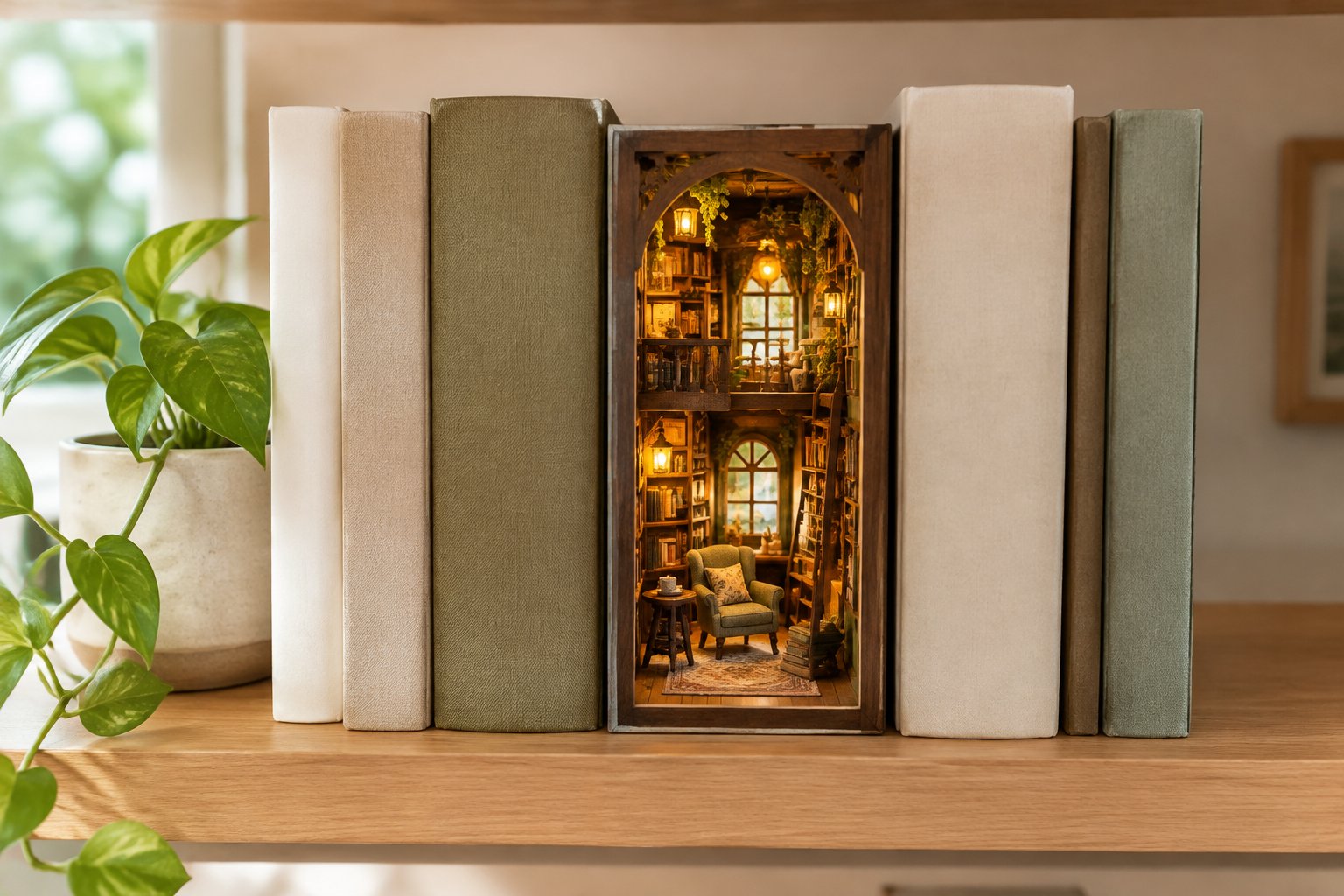
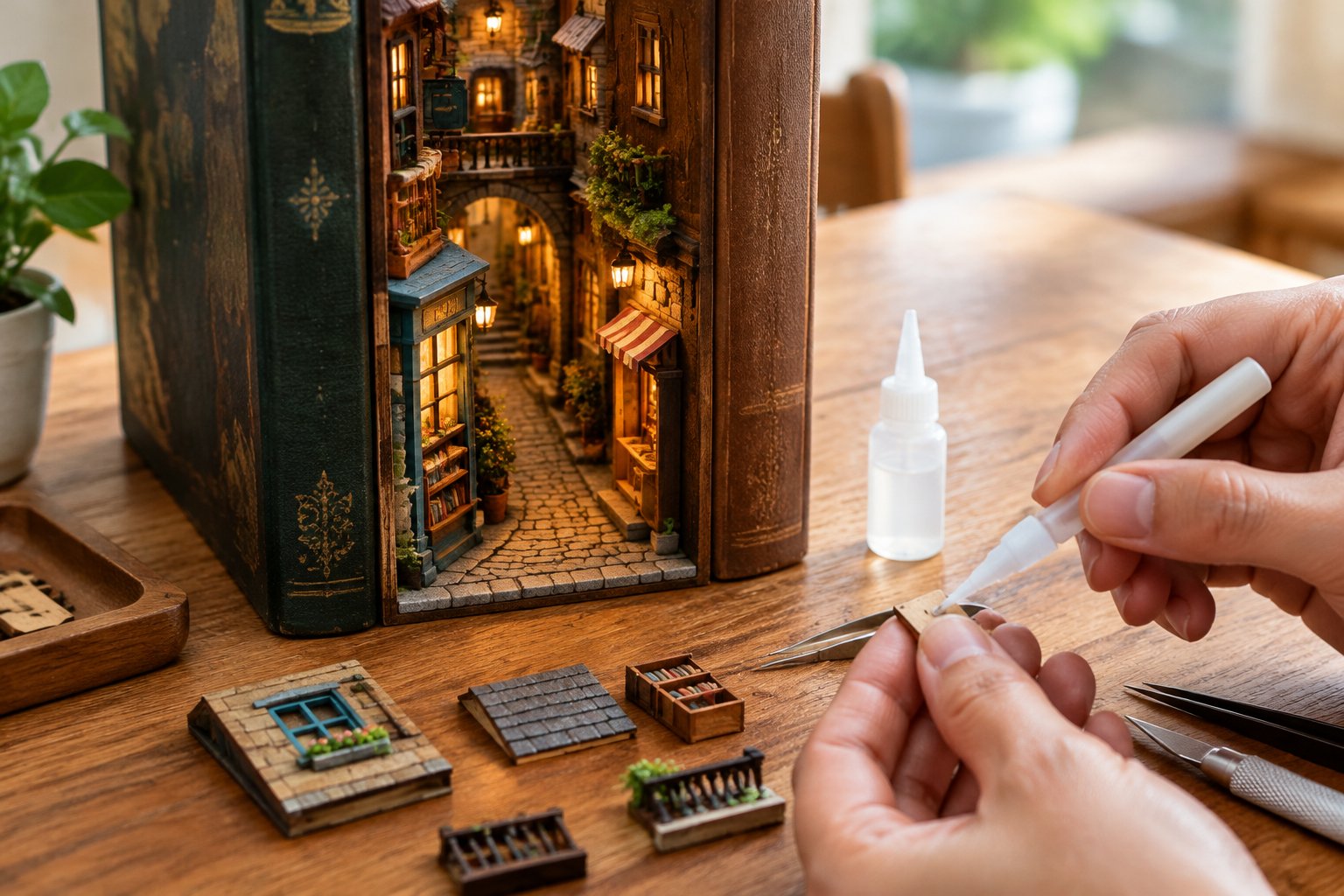
A Japanese book nook is a small lit diorama that stands between books on a shelf and shows a Japanese scene, usually a Tokyo back alley, an old Kyoto street or a cherry-blossom lane. Most are sold as DIY kits of pre-colored, laser-cut parts with LEDs, priced from $39.99 to $99.99 on brand stores.
Which Japanese book nook is best for a beginner?
Rolife's Sakura Wine Alley ($49.99) is my pick: Rolife rates it 3 of 5 and estimates 3.5 hours. CuteBee's Morita-Ya ($39.99, two stars, 3–5 hours) is the cheaper easy option. Sakura Densya is often recommended to beginners, but Rolife rates it 4 of 5.
Will a Japanese book nook fit an 8-inch-deep shelf?
Yes, every kit in this comparison is under 8 inches deep, from 4.5 inches (Sakura Densya) to 7.8 inches (Tsutenkaku Ichiban Street). Check height too: most stand 8.7 to 9.6 inches tall, so a shelf with about 10 inches of clearance is the safe minimum.
Which batteries do Japanese book nooks take?
Most take two AAA batteries, including all the Rolife and CuteBee kits here and two of the three Anavrin kits. Tonecheer's Japanese Grocery Store takes three AA, and Anavrin's Golden Gai takes three AA or a USB-C cable. Batteries are usually not in the box.
Do I need glue for a Japanese book nook?
Often, yes. Rolife's Sakura Wine Alley needs none, and CuteBee's snap-fit kits use less, but CuteBee and Tonecheer say glue may not be or isn't included. Anavrin's pages contradict themselves on glue. Plan on a bottle of quick-dry craft glue unless the listing clearly says otherwise.
Can a first-timer finish one in a weekend?
Yes, if you pick a short kit. Sakura Wine Alley (3.5 hours), Falling Sakura (3 hours) and Morita-Ya (3–5 hours) fit comfortably into a weekend by their makers' estimates. The 6–8 hour kits usually take two or three evenings, and fine detail takes longer than any estimate suggests.
Is the scene a real place in Japan?
Some are. Anavrin's Omoide Yokocho and Golden Gai are named after real Shinjuku alleys, its Kyoto Gion is set in Kyoto's Gion district, and CuteBee's Tsutenkaku Ichiban Street is named for Osaka's Tsutenkaku area. Sakura kits like Falling Sakura and Twilight Sakura Path are moods rather than real places.
Will a Japanese book nook arrive before Christmas?
Rolife ships in-stock kits from a local warehouse in 3 to 5 business days, and CuteBee takes 5 to 15 business days. For Tonecheer and Anavrin, check the shipping estimate on the listing.
I compare kits using makers' published specs, brand listings and buyer reports. I haven't built these kits. ShelfWorlds doesn't sell kits, and there are no affiliate links on this page. More on how I rate kits.